Children’s class enrolments for 2027 are not yet open.
Email hello@circlestudios.com.au to join our mailing list!
Kids
Classes
If you’re interested in joining us in 2027, please join our mailing list or contact us for more information.
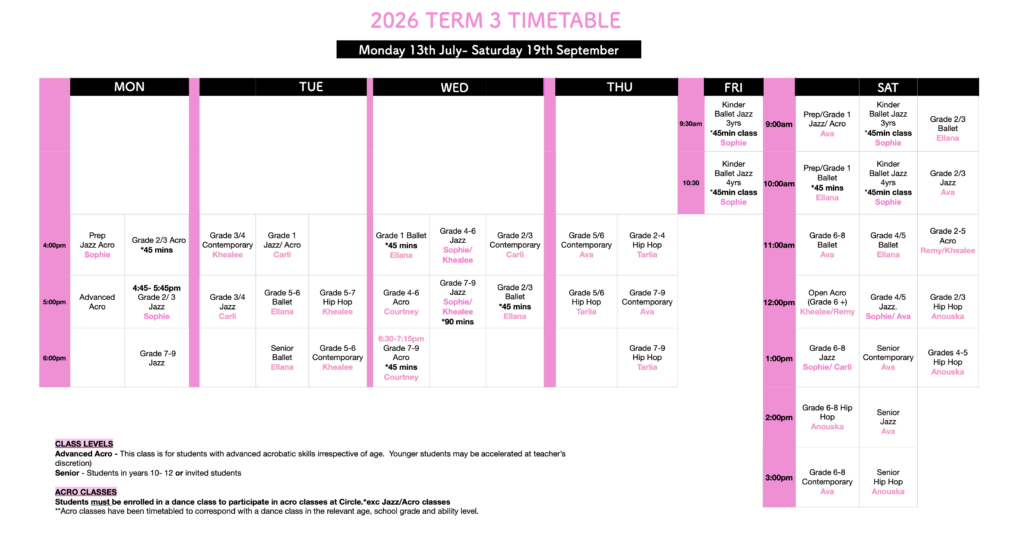
Term 1 Dates
Saturday 31st January – Thursday 2nd April
*Public Holiday Monday 9th March – Labour Day
Term 2 Dates
Saturday 18th April – Saturday 27th June
*Public Holiday Monday 8th June – Kings Birthday
Saturday 25th April – Anzac Day
Term 3 Dates
Monday 13 July – Saturday 19th September
Term 4 Dates
Monday 5 October – Saturday 5th December
*Public Holiday Tuesday 3rd November Melbourne Cup – No classes Monday 2nd & 3rd November for the long weekend
CIRCLE CONCERT
Date : Thursday 19th November
Performance Time: 6:00- 8:00pm
Venue: The Melbourne Recital Centre, Elisabeth Murdoch Hall, 31 Sturt St, Southbank VIC 3006
This performance is for our 4-year-old Kinder classes and above.
Performance Day & Technical Rehearsals
Please note that on the day of the performance, students are required to participate in a technical onstage rehearsal as part of the venue’s compulsory OHS requirements.
3-Year-Old Kinder Class in-studio performance
Our 3-year-old Kinder students will have their own special and intimate in-studio performance @ Circle during Term 4 (Date TBC.)
2026 Class Prices
Dance Classes
- 45-minute dance class: $260 per term
- 1-hour dance class: $270 per term
Acro Classes
- 45-minute acro class: $270 per term
- 1-hour acro class: $290 per term
Multi-Class Discounts
Applies per child/student per term.
- 3 or more classes: 10% off
- 5 or more classes: 15% off*
Uniform Policy
Students must wear required uniform and dance shoes.
JAZZ/ ACRO/ CONTEMPORARY
Uniform: All black – any combination of slim fitting dance wear ie. leotard, singlet, crop top, bike shorts and/or leggings.
Footwear:
Jazz: Black jazz shoes
Jazz/Acro: Black jazz shoes
Acro: Black acro shoes *only available from Bloch
Contemporary: Foot thongs , Knee Pads (Optional) for senior students
BALLET / BALLET LYRICAL
Uniform: Prep and above require a black ballet uniform. (Uniforms available at Capezio & Bloch stores)
Footwear: Pink ballet slippers. No Jiffies. Theatrical pink tights for colder months.
KINDER BALLET & JAZZ
Uniform: We encourage our little dancers to wear a combination of leotard and skirt in pink or lavender dance wear. No costumes. Theatrical pink tights for colder months.
Footwear: Ballet slippers. No Jiffies.
HIPHOP
Uniform: Black dance or streetwear – baggy tops/pants preferred.
Footwear: Sneakers.
Injury/Absence
Injury
At Circle, we focus foremost on the safety of our students.
We make every effort to teach our students with this safety in mind, focusing on Safe Dance Practices as outlined by Ausdance Australia including the three core areas of Effective Teaching Methods, Safe Dance Environment and Professional Business Practices for Studio Teachers.
If a child requires rest from physical activity due to injury, we offer makeup classes for all classes missed. If injury allows, we recommend students come in and watch their classes during the time they are injured. Following recovery, students are encouraged to participate in any genre of class in their age group.
If a child is injured or unwell for an extended period of time (more than 3 weeks), our policy is to defer fees to future classes or the following term. Please contact us to discuss options.
Absence & make up classes
If your child is going to be absent from class, please email us and in the subject line put ABSENCE and the child’s name.
Students who have registered their absence via email may attend make up classes in any genre within their age range, to make up for classes missed.
Make up classes must be taken in the same term as the absence.
Children whose classes fall on a Public Holiday are entitled to a make up class for classes that fall on that day.
We do not refund or pro-rata fees for classes missed due to holidays, school camps, parties etc.
Class styles
KINDER BALLET & JAZZ ( 3 & 4YRS)
These classes are age-specific dance classes designed to teach dance skills and musicality through imaginative exercises, in addition to structured syllabus exercises. The classes are fluid and we respond to the children’s interest, ideas and moods. We aim to cover the following during the course of the year:
dance basics – straight backs, stretched legs and feet, bending knees before jumping, jumping from and to 2 legs, bounding from and to 1 leg, demi pointe runs, skips, side gallops, picked up gallops, marches, basic turns, softened arms and hands
basic ballet positions and terms (bras bas, first & fifth position of the arms, parallel and first position of the feet, demi pliés, sautés, demi pointe, retirés, arabesque, penchés)
story telling, imagination and performance (i.e. – we create exercises and dances around a character and story – Cinderella going to the ball/baby birds leaving the nest and learning to fly/children picking flowers in a field etc )
class etiquette (making circles, taking turns, dancing with a partner, following instructions, working as a group, focusing)
musicality, rhythm, co-ordination, creating a sequence of steps
dance games
We use a variety of music – classical, age appropriate pop music, music from popular children’s movies, in addition to the pre-primary RAD ballet syllabus. We also use a large volume of props – to give the class interest and shape.
JAZZ
Jazz classes are fun, high-energy dance classes that combine technique with popular music and movement patterns. Jazz classes are very popular with students – they enjoy the freedom of movement while gaining genuine satisfaction as they build on their skills each week.
Jazz classes generally have the following structure:
a cardio warm up;
stretching;
age appropriate core strengthening and balance work;
isolations;
turns in the centre (pirouettes, tours, pencil turns etc);
kicks and combinations travelling down the room;
corner work including travelling turns, jumps, leaps, cartwheels;
during the final 15 minutes of class, the children learn a routine to a popular song. Generally, we learn and add to the same routine for 4 weeks so that the children develop their ability to retain choreography, master the steps and work on performance quality.
CONTEMPORARY
Contemporary dance is an ever-evolving dance style that stemmed from the rigour of classical ballet through an exploration of movement styles, musicality and creative expression.
Contemporary classes may include elements of lyrical dance (an expressive dance form using lyrics of music to assist in telling a story), ballet (technique basis for many dance styles), improvisation (spontaneously creating movement in response to a stimuli) and floor work.
In a contemporary class, students explore levels, learning rolls and ways to move in and out of the floor, as well as travelling steps and expressive choreography.
Classes include:
1.A warm up, isolating various parts of the body and working through the spine. 2.Improvisation or creative responses, where students are encouraged and supported to explore their own movement style whilst being guided by the teacher
3.Floor work, rolls, leg swings
4.Exercises exploring some of the key aspects of contemporary dance, including contraction & release, triplets, parallel positions, levels and movement dynamics
5.Learning a routine or phrase, to a song with or without lyrics, exploring expression through movement. This element of class extends students in the areas of learning and retaining choreography, performance skills, confidence and style
HIP HOP
Hip Hop is a fun and challenging dance style that develops coordination, musicality, confidence, style and dynamic. Hip Hop classes focus more fully on learning choreography. Students gradually develop the ability to learn and retain large volumes of choreography, and to execute moves with increasing accuracy, dynamic, speed and strength.
Junior Hip Hop classes generally include the following elements:
a cardio warm up;
stretching;
strengthening;
isolations;
basic party moves eg. Running Man, Cabbage Patch, Reebok and Whip/Nae Nae (these moves develop rhythm and often require students to use the arms in opposition to the legs);
breakdancing footwork, freezes and tricks such as the Top Rock, 6 Step, Baby Freezes, Coffee Grinder, Worm and Wave;
students learn and add to a routine over approximately 4 weeks.
Class may finish with a game or a Cypher. (A Cypher is where the students form a circle and everyone gets a go to jump in the middle and show off their best moves!)
In Intermediate and Senior classes, warm up is generally immediately followed by choreography, which increases in complexity as the year progresses, and incorporates patterning and cannons. Students work to develop musicality, dynamic and quality of movement.
ACRO For Dancers
In our acro classes, students learn tumbling and balancing components of gymnastic and circus arts. Classes develop body awareness, strength, agility, balance, co-ordination and flexibility. Students must challenge themselves and overcome fear in order to master tricks, aerials and flips.
Some of the skills learned include cartwheels, handstands, chinstands, aerials, walkovers, handsprings, back and front tucks etc. Tricks and skills learned during acro students are frequently incorporated into jazz, contemporary and hip hop choreography.
TAP /MUSICAL THEATRE
In this class, students explore the genre of Musical Theatre and focus on storytelling through song and dance. The teacher selects material for the class that is age appropriate and gives the students room to develop characters within the choreography they learn. Classes commence with a series of acting, improvisation and character building games/ exercises to develop acting technique and help to gain confidence. Students are encouraged to experiment and make bold mistakes, and are provided with constructive feedback after each exercise.
Students learn the lyrics to the chosen song, and sing as a group, with a focus on projection and diction (as this always gets lost when they start to learn choreography).
In Musical Theatre, the songs and music are designed to help progress the plot of the show and offer insight into the characters. Therefore every beat, accent or shift in the music is important and students work on co-ordination, timing and musicality in class. It is essential to be able to master ensemble singing and dancing, matching the steps and lines the teacher is demonstrating and listening to the music so that every dancer is dancing as one. This gives the routine a cleanliness and intensity.
It is also important to develop individual characters that stand out within this ensemble. There are moments in each song that give the students the opportunity to sing individual lines, do individual choreography and use their imagination. The challenge is finding the balance between performing in sync with the other performers and performing with characterisation.
Enrolment
Families are encouraged to Enrol Online .
If you have any questions about enrolment, or which classes will best suit your child, please email us at hello@circlestudios.com.au and we will get back to you as soon as we can.
Students are generally enrolled faithfully in their school year level but we will move them to an alternate class based on ability if necessary. Teachers will assess and communicate with parents and students if they need to be moved up.
ACRO Enrolment: Students who take Acro must also be enrolled in a dance class ( in any style) at Circle Studios.